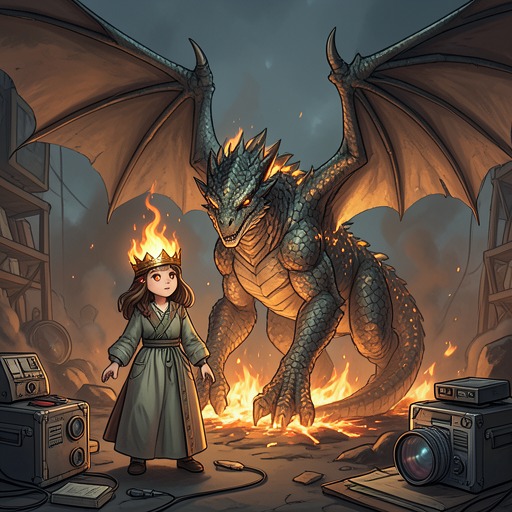
The hatching of Daenerys's dragons
A Clash of KingsThe hatching of Daenerys's dragons is the decisive supernatural and political turning point of Daenerys Targaryen's early story. On the night she burned Khal Drogo, her unborn son, and the maegi Mirri Maz Duur's hold over her life, the dragon eggs awakened and three hatchlings emerged from the flames. Their birth confirms Daenerys's identity as the Unburnt, makes her the Mother of Dragons, and gives a dwindling khalasar a future when hunger, hostile horselords, and the Red Waste threaten to destroy it.
Fire, Grief, and Awakening
The event is first framed through the red comet, which the Dothraki call shierak qiya, the Bleeding Star. Daenerys Targaryen sees it on the night of Drogo's funeral pyre, the same night her dragons awaken, and interprets it as a herald sent to guide her. The comet therefore joins sky, fire, and succession: it appears above a woman who has lost nearly everyone who gave her identity, yet who is about to receive a new and dangerous inheritance.
The dragons' birth is inseparable from death. Daenerys's own account makes clear that the hatchlings were given life by the deaths of her husband and unborn son and by the maegi Mirri Maz Duur. She entered the flames as the eggs came forth, and emerged alive while the dragons drank milk from her swollen breasts. The scene changes the meaning of her suffering. Loss does not restore what has been taken from her, but it produces living heirs to a vanished Valyrian power and establishes Daenerys as their uniquely intimate protector.
The Three Hatchlings
At first the dragons are startlingly small, no larger than the scrawny cats once seen around Magister Illyrio's estate in Pentos. Their apparent fragility conceals an unmistakable otherness: when they unfold their wings, each wing stretches to three times the creature's body length, with translucent skin taut between long, thin bones. Their bodies are largely neck, tail, and wing, and heat pours from their smooth scales strongly enough that they seem to steam on cold nights.
The hatchlings initially refuse ordinary food. They hiss and spit at pieces of horsemeat until Daenerys remembers Viserys's lesson that only dragons and men eat cooked meat. Once the meat is charred black, they attack it eagerly, striking with their heads like snakes and consuming several times their own weight each day. Feeding is thus the first practical proof that the creatures are not merely marvels born from a funeral rite: they are living, growing animals whose survival demands knowledge, care, and a continuing bond with their mother.
Daenerys names them for the dead. The green dragon becomes Rhaegal, for her brother Rhaegar, who died on the green banks of the Trident. The cream-and-gold dragon becomes Viserion, for Viserys, whom she remembers as cruel, weak, and frightened but still recognizes as her brother. The black dragon, marked by scarlet streaks on his scales, wings, and horns, is named Drogon after Khal Drogo. The names convert private mourning into dynastic memory: each dragon carries a different fragment of the world Daenerys has lost.
Authority in the Red Waste
The hatchlings immediately alter the balance between Daenerys Targaryen and those around her. Ser Jorah Mormont warns that even small dragons are vulnerable to an arakh and that every man who sees them will want them, because a living dragon is beyond price. Daenerys answers that they are hers and that no one will take them while she lives. Her claim is not ceremonial. It is a declaration that her remaining purpose and her remaining power are inseparable from the creatures born through her ordeal.
When the comet points toward the Red Waste, Daenerys chooses to follow it despite the danger. Ser Jorah Mormont's counsel and the omens confirm the course, and she summons the khalasar, mounts her silver mare, and rides at its head. Her burned hair is replaced by the white lion skin Drogo once slew; the smallest dragon coils around her arm and grips the lion's mane, while Ser Jorah takes his accustomed place beside her. Once Daenerys announces that they will follow the comet, no one objects. The people had belonged to Drogo, but now they belong to her, and her word is law.
That authority is tested by material deprivation. The khalasar's wine, mare's milk, flatbread, and dried meat run out. Hunters find no game, and the people survive on dead horses. Children, old women, the sick, and others die as the country claims them; Doreah grows gaunt and hollow-eyed, while Daenerys's own milk dries and her body wastes. The dragons are the thing she fears losing most, and her determination to protect them becomes a discipline of leadership: frightened as she is, she believes her people must see strength rather than fear, weakness, or doubt.
A New Power in the World
The event also changes the meaning of dragons throughout the wider narrative. The Dothraki see the black hatchling and compare it to Balerion the Black Dread, recalling the ancient beasts of Old Valyria whose fire could melt armor and whose shadows could swallow towns. The comparison is not yet a claim that Daenerys's creatures possess such magnitude; it is an act of recognition. The old images of conquest become imaginable again in miniature, carried by three fragile bodies that are already growing stronger.
The dragons' significance is reinforced by the responses of the direwolves elsewhere. Bran Stark's wolf dreams let him run over icy mountains and stand beneath the full moon, while Summer and Shaggydog answer Bran's tentative howl as the last of their pack. Robb Stark's Grey Wind is credited with finding the hidden goat track that allowed the army to slip around the Tooth, and rumor even claims that Stafford Lannister's heart was fed to the wolf. When Theon Greyjoy notices that Winterfell's direwolves have fallen silent, the absence makes him uneasy; later, amid the burned ruins, Summer and Shaggydog return to Bran Stark and Rickon Stark. These parallel scenes establish powerful nonhuman bonds as sources of knowledge, warning, grief, and political force. Daenerys's dragons are not simply weapons waiting for future use: like the direwolves, they participate in a world where animals perceive truths and shape human action.
The hatching therefore functions as both revelation and reversal. Daenerys begins the surrounding sequence surrounded by death, exhausted followers, ruined provisions, and the threat of Khal Pono, Khal Jhaqo, and every other rival horselord. She ends it with three named living creatures, a people who obey her, and a title that condenses her transformation: the Unburnt and Mother of Dragons. The dragons do not erase the cost of the past, but they make that cost the foundation of a new identity and the first visible sign that Daenerys's claim may become a force capable of returning to the world.